
Featured pages
Luminous Green 2007
Possible Futures...
Active Discussions...
Table of Contents
PhoEf: The Undisclosed Poiesis of the Photovoltaic Effect
PhoEf is a research project by Bartaku [Bru/BE] with explorations in the micro and macro realms of Photovoltaics: the conversion of light energy into electrical energy. It is situated at the interstices of arts, science and technology. PhoEf started off as a residency at FoAM Brussels, cultural lab in 2007. Ever since, PhoEf meanders in various directions, ending when it will end.
The content of this micro-site is PhoEf's digital compost which fuses micro-interventions, workshops/-labs, writings and lectures.
PhoEf - The Undisclosed Poésis of the Photovoltaic Effect

PhoEf emerges from a personal, transversal flight through the interconnected worlds behind and around photovoltaics; a technology based on A.E. Becquerel's 1839 observation of the photovoltaic effect.
As photovoltaics illustrate the interwovenness of matter and mankind, with the elements and the cosmos, it promises to trigger a deeper understanding of the qualities, origins and movements of light. Of the Sun. PhoEf provides both sky and earthbound information, sometimes structured alongside linear vertical paths, only to make an abrupt stop. Finding junctions between intuitive text and the flowing of new (inter)connections in an attempt to reach, inspire and connect researchers, developers and artists.
As light is the primary source of energy of photovoltaic technologies, they are subject to the schizophrenia of the photon's behaviour as both wave and a particle, their multiplicities; healthy to dangerous, subtle to aggressive, absent to abundant and from invisible to tangible. Might it lead to just enough energy for an electric kiss, or to the rise of a Buddha? PhoEf wants to contribute to a further dynamic exploration of the complex relation between light, electrical energy and the media that can be used to represent it.
Writings
** Book, Essays, Papers … **

“Article” Wait and Hear 2025, `Exercises in Perpetual Company´, in M Ambrózy, I Butkutė, S Durand, P Marozas & A Žudys (eds.), Landing, no.1, pp. 275–286 Note: Wait and Hear is an international and transdisciplinary group of artists Jan Christian Schulz (NL/GER), Joshua Le Gallienne (UK), Till Bovermann aka LFSaw (GER), Mari Mäkiö (FI), art H.M. Vandeput (Bartaku Art_Research; BE and anthropologist Alicja Staniszewska (FI/PL)
“Book Chapter” Vandeput, B 2024, `Baroa belaobara: An artist-plant based work tying language and creatures into hybrid beings´, in P Gibson, S Jottkandt, M Sierra & A Westbrook (eds), The Herbarium Tales Seedbook, The Herbarium Tales, vol. 1, Open Humanities Press, London, pp.128-139.
“Article” Vandeput, B & Berndtson, P 2022, `Plant Steaming Concrete Staining ́, Research in Arts and Education, vol.1, pp. 66– 74. Peer-reviewed essay with respiratory philosopher Petri Berndtson. Thematic issue of the journal volume: On Animals, Plants, Bryophytes, Lichen, and Fungi.
“Monograph” Vandeput, B (Bartaku) 2021, Baroa belaobara: berrybabe, Aalto ARTS Books, Espoo (Fin), 263p. Online as pdf; Order Print version
“Article” Stadlbauer, C & Bartaku. (2020). `The (Im)possibility of Communicating with Other Species´, Performance Research, 25:5, 45-48, DOI: 10.1080/13528165.2020.1868840. Video - Relocation Training Program for Pinna Nobilis
“Article” Bartaku. (2019). Seed Scarification. In: Birringer, J., Fenger, J. (Eds.), Tanz der Dinge / Things that Dance. Yearbook of the German Dance Association 2019, vo. 29. (pp. 193-198). Transcript Verlag. Bielefeld, Germany.
“Paper” Aronia m.BaBe: Berry-artist(ic) Research. Presented at Symposium on Electronic Art (ISEA) / Festival de la Imagen. In Conference proceedings, p.772. Manizales (Col), June 12, 2017.
“Encounter with Prof. Kalevi Kull (Tartu University, Estonia) on a Biosemiotics view on life, cognition, consciousness” Tartu University, Oct. 9, 2015 - Full text (pdf)
“Edmond A. A Displaced System for Alpha-Repair” and interview. In: Acoustic space #8. Energy. Peer-reviewed Journal for Transdisciplinary Research on Art, Science, Technology and Society Edited by Šmite, R., Medosch, A., Mey, K., Šmits, R. RIXC, MPLab, Riga, Liepaja [LAT], 2011
“Edmond A. A Displaced System for Alpha-Repair”. In: Wynants, M. (Ed.). 2010. We can change the weather. 100 cases of changeability. Brussels: Crosstalks, Brussels University (VUB). 225p. ISBN: 978 90 5487 692 2 Excerpt and order information
An essay-like text written during the residency at Periferry in Guwahati, Assam (India) appears as Case 33 in this book by VUB-Crosstalks (Brussels University) that is “comprised of one hundred tangible local initiatives from around the world, engaged in social and ecological change. Drawing from a pool of personally driven research and bottom-up projects by scientific researchers, architects, artists, political thinkers and entrepreneurs, the book singles out 100 cases in different, yet interrelated domains…”
See also Case 4: by FoAm member Angelo Vermeulen & Diego Maranan. “Biomodd as a Paradox” and Case 38: by FoAM & Partners. “Resilients”
“The Case of Edmond A. A Displaced System for Alpha Repair.” was also published in Assamese translation in the Assamese weekly: > Pratidin Sadin. February 12, 2010. p. 14. Assam, India.
On Resilience: interview after FoAM Resilients Gathering (What does resilience mean for you - read here)
To feed the interdisciplinary debate during 'Crosstalks - The Atomium Session' on May 14th, 2009, the speakers were asked to reflect upon some quotes and questions. This is one of them: […] “In investigating the roots of our current environmental dilemma and its connections to science, technology and the economy, we must re-examine the formation of a world view and a science which, by reconceptualizing reality as a machine rather than a living organism, sanctioned the domination of both nature and women. The contribution of such founding 'fathers' of modern science as Francis Bacon, William Harvey, René Descartes, Thomas Hobbes and Isaac Newton must be reevaluated.” Carolyn Merchant in The Death of Nature, 1980 crosstalks_reflection_bartaku.pdf
“Three Urban Energies divided by 10min” Text of 'intervention' by Bartaku at “Conversations 48 Degrees Celsius” → Session 1: City Space and the Everyday Intervention: The inter-connectedness of the built environment, social and environmental sustainability. June 13, The Park Hotel, Delhi. The 'Conversations' are part of 48°C Public.Art.Ecology Arts Festival, Delhi (India), Dec. 2009.
PhoEf - The Undisclosed Poésis of the Photovoltaic Effect. Paper for the 23rd EU Photovoltaic Conference, Feria de Valencia (Spain), Sept. 2008. “Paper; PDF” “Presentation; PowerPoint as PDF)”
Overview Bartaku Light-Energy-Bodies Work in Public
Exhibitions, Interventions
→ Visual complements contribution to the book `Chance Encounters: A Bioethics for a Damaged Planet´ by bioethics Prof. Kristien Hens, Dec. 2022.
→ Exhibition & Masterclass At UPDATE Festival, MPLab, Liepaja University (LV), Nov. 21-26, 2022
→ Retinalalian Group Hum_2: breathing-sounding the retinal code** Performative experiment. At Airy Encounters: Respiratory Philosophy and Sound Arts. Co-organized by Institute for Philosophical Studies, Science and Research Centre Koper, Slovenia and the Sibelius Academy, Uniarts Helsinki. Sibelius Academy and Suomenlina, Helsinki (FI), June 6-8, 2022.
→ Retinalalian Group Hum_1: breathing-sounding the retinal code** Performative experiment. At: Emergence, Microbes, Governing Bodies Mini Festival. By Vision Forum. SOLU, Bioart Society, Helsinki (FI), June 1-5, 2022.
→ Towardless_X Mixed media installation. With Dr. Janne Halme (New Energy Technologies Group, Aalto University). At X-Festival, by X-LAB, University of Hasselt (BE), 19-29 October 2021.
→ Towardless: Plant-based Electrical and Art Energy Mixed media installation. With Dr. Janne Halme (New Energy Technologies Group, Aalto University), Helsinki Design Week, Väre, Aalto University, Espoo (FI), Sept. 8-29 2021. https://www.aalto.fi/en/events/towardless-plant-based-electrical-and-art-energy-virtual-exhibition.
→ Blck Vlvt - Mixed media installation. By Aamo artscience group. Group Exhibition: Outré: encounters with non/living things. https://www.aalto.fi/en/events/outre-encounters-with-nonliving-things. V2 Gallery & Virtual, Aalto University, Espoo (FI), Nov. 19–Dec. 7, 2020.
→ Baroa b. wordings - Performative reading. Part of RE/WORDING, Disruptive Processes at Research Pavilion #3 Info Lab, Exhibition Laboratory, Helsinki, (Fin) 25.10-17.11 2019 Part of RE/WORDING: Collaborative Writing in Public Space 2019 By Lena Séraphin. University of the Arts Helsinki’s Research Pavilion.
→ Leaky Light - Solo exhibition. Three selected works. SOLU, Helsinki (Fin). Aug. 27-Sept.26, 2019.
→ Live wordings to Baroa b. Part of RE/WORDING: Collaborative Writing in Public Space 2019 By Lena Séraphin. Research pages. Otaniemi, Espoo (Fin) and Venice. June 14-16 2019.
→ Seed Scarification: Serious Taking - A seed-y sound/light installation. Part of exhibition of the Tanz der Dinge/Things That Dance Symposium 2018. By Gesellschaft für Tanzforschung. At Karlsruhe Institute of Technology, Karlsruhe (Ger). October 5 - 7, 2018.
→ Leaky Light: Paper Protocol, Rhythm Protocol (4×3)+(1×4), Baroa belaobara from Aizpute Bacterial Root Symbionts protocol (accidental documentation) - Installation; group exhibition: “Porcelain Identity”. Part of the “Kaunas Bone China Symposium '18, by Vilnius Academy of Arts. A Mixed Media Installation. Exhibitions: M. Žilinskas Art Gallery, Kaunas (Lit). July 13th – August 30th 2018, Gallery Akademija, Vilnius (Lit). Sept. 17-29, 2018, Panevėžys Art Gallery, Panevėžys (Lit). Nov. 9th – Dec. 1st, 2018,
→ Aroniathon I - Photographic intervention. Part of Group Exhibition OBJEKTI 4. Espoonportti, Espoo (Fin). June 14–Sept.2, 2018.
→ OtAronia m. Ba.be Distributed Plantation Walk - A Bartaku WalkTalk on Otaniemian Aronia m. Babe Distributed Plantation, Part of Artistic Interventions of The European regional Congress of InSEA (International Society for Education Through Art). Aalto University, Otaniemi Campus (Fin). June 20, 2018.
→ Sandy Tower, Leaky Method - Intervention. Group exhibition Rising Up Floating Down / Was aufsteigt und niederfließt. Wasserturm Favoriten, Vienna (Aus). May 24 & 25, 2018.
→ Troping Turner. Towards Prpl. Vlvt. - Installation, mixed media. Group Exhibition: Sustainability Revolutions. Dipoli, Aalto University, Otaniemi Campus, Espoo. May 18-June 8, 2018.
→ zNap: A Nap Happening At main venue of the Radical Relevances Conference. By Anne Glassner and Bartaku. Aalto University, Espoo (Fin). Apr. 25-27, 2018.
→ Rapchiy and ´earth minor {3/19, 1/11 (22[33]), 2/29} ft. The Path of Dormant Seed - A Leaky-Assemblage´. Medium / material: patchwork, digital print, mountain bricolage + Glass vessel, Baroa b. seeds, Agar Agar, Leaky BaroaJuiceAgar, BaroaJuceStainedStone). By Mirko Nikolic and Bartaku. At Radical Relevances Conference. Aalto University, Espoo (Fin). Apr. 25-27, 2018.
→ Rapchiy - Performative Happening. At Appleing Festival. Serde Arts Center. Aizpute (Lat), Sept. 9, 2017.
→ New Aronia - Wall painting and photos. Group exhibition of Frontiers in Retreat (5-year project on Art & Ecology (supported by ´E.U. Culture´). Serde Art Center, Aizpute (Lat), July 1, Sept. 11, 2017.
→ Rapchiy - Performative Happening. At Symposium on Electronic Art (ISEA) / Festival de la Imagen At the Universidad de Caldas, Manizales (Col). June 15, 2017.
→ Berry BaBe - Performative happening. At Pixelache Festival. In collaboration with the students of the MA Ecology and Performance, Theatre Akademy, University of the Arts (Uniarts). Part of Frontiers in Retreat. Lapinlahti Lahden (former hospital). Helsinki (Fin). Sept. 20 > 25, 2016.Flickr
→ Finnishing Flagging - Rural traffic intervention with future Aronia m. berry & co. With Seila Fernández Arconada (UK/Sp)and Anna Rubio (Sp). With support of IdeaHouse and Serde Arts Center. Part of Frontiers in Retreat. Aizpute (Lat), Sept. 14, 2016.
→ In Between Storage - Hangar Intervention: collective reshuffle_exhibition in hangar on Aronia plantation. Artists: Anne Glassner (Aus), Bartaku (Fin/Be), Seila Fernández Arconada (UK/Spain), Laurie Sheridan (US). With support of Serde Arts Center. Part of Frontiers in Retreat. Aizpute (Lat), Sept. 2,3 & 10, 2016
→ Aronia Babe - Selected works. Group show Biofilia OPEN. Part of Aalto festival. Biofilia/Lumarts. Aalto University, Espoo. May 20, 2016.
→ BorFil - Open Studio with speculations on the transformation of a mining truck into a single wire: Kolubara open pit mine dust, Video, Photos, Sculptural performance, various objects. In collaboration with Dusko Jelen (photography). At KC Grad (European Center for Culture and debate), Belgrade (Ser), Feb. 15-19, 2016. As part of Frontiers in Retreat. See Flickr
→ Aronia Overture - The essence of the Aronia Berry in 11 movements. At Q-O2 (workspace for experimental contemporary music and sound art) Winter Festival: Interpretations. Brussels, Dec. 04 - 07, 2014. Co-created with Ruta Vitkauskaite (composer; Lon.) and Karl-Heinz Jeron (sound artist; Ber.)
→ Aronia Overture - The essence of the Aronia Berry in 11 movements. Post-residency presentation at QO2. Serde Appleing Festival. Aizpute, Sept. 13, 2014. Co-created with Ruta Vitkauskaite (composer; Lon.) and Karl-Heinz Jeron (sound artist; Ber.)
→ Aronia Overture - The essence of the Aronia Berry in 11 movements. Riga White Nights / Cultural Capital, Sept. 6, 2014.
→ Aronia Overture - The essence of the Aronia Berry in 11 movements. Post-residency presentation at QO2. Brussels, May 4, 2014.
→ HOOPGAS TestLLLab - Artistic Research in Public. Observing that the Woman-In-Law´s Tongue, the agave of the Lower Countries, seldom comes to flowering, we investigate what role plant hormones, like ethylene from bananas could play. Dec. 10, 2013 > Jan 18, 2014 (Fri & Sat.). Natlab Baltanlaboratories): Kastanjelaan 500, Strijp, Eindhoven (Hol). Flickr photographic Dokumentation
→ MaizMaguey - Exhibition Group exhibition with works made by Brussels and Oaxacan based artists and craftsmen. Art Space In Between, Brussels. Oct 26, - Oct. 29, 2013. Project site
→ Nube-de-Oro Research Gathering #2 / Exhibition. Jardin Etnobotánico de Oaxaca de Juarez (Mex), June 25th, 2012. More
→ Hotel Resilients - Group exhibition: Ten rooms at the second floor of a vintage hotel with a mixture of installation and performance that prototype possible futures as artistic explorations in living and working environments. about; Hotel Le Berger, Brussels (BE). March 23, 2013. Flickr
→ AroniaFlax Table Landscape feat. tpED At Central Saint Martins College of Arts and Design, Arts University London. Jan. 1st, 2013. Part of Resilients.
→ Boo! at 'The Flottila' Being Agave at the vessel and community 'The Flotilla' celebrating Anti-Apocalypse Day. Brussels (BE). Dec. 12, 2012. Part of Resilients.
→ Nube de Oro. Installation. Part of the 'Fiesta de Maiz y Maguey' group exhibition, Ethnobotanic Garden of Oaxaca (MEX) Nov 25, 2012 > Jan. 23, 2013. http://euroaxaca.org/case-studies/fiesta-de-maguey
→ Aroniathon/2 #2: Walk The Stick (and Trick the Tick). Part of the APP Ephemeral Ritual Series. At 'The Aronia Power Plantation (APP)' Aizpute, (Latvia). Sept. 30, 2012 - Part of Resilients
→ Aroniathon #1 - Part of the 'APP Ephemeral Ritual Series'. At 'The Aronia Power Plantation (APP)' Aizpute, (Latvia). Sept. 23, 2011. Also see the essay based on the history of Aronia M., from a former West to a former East: http://libarynth.org/luminous/phoef#aronia_m_a_stand-by_power_plant_in_intermediary_times
→ ‘Aronia Power Plantation - Days of re-Initiation’ Aronia Melanocarpa (Chokeberry) centered action, processing and mixing old/new, east/west rituals, crafts, formulas, methods and recipes: Collective harvesting, russian jams and syrups from the 20ies, wine, beer, 'authentic' candy with sweetening experiments; dying textiles with left overs (quince, salt and vinegar as mordants). Part of residency at Serde, Aizpute (Latvia). Sept. 2011.
→ Midsummer Expedition to Kurzeme, Latvia Expeditions to Rucava, Kalvene, Alsunga, June 20-25, 2010. “An expedition of fieldwork in small villages of Kurzeme region, building upon SERDE’s experience of engaging cultural heritage subjects as an arts organisation. Here the Herbologies/Foraging Networks project aims to preserve and document traditional cultural values related to herb-gathering in Latvia, promoting and developing a more diverse society than the traditional understanding of the cultural manifestations of the past and today, the identification and assignment needs.”
→ A Slow Flow > Site specific installation & workshop at Periferry 1.0 - Brahmaputra/Guwahati, Assam, India - Feb. 14&15, 2010. Made during a residency periferry_-_residency_bartaku_-_preliminaries.pdf - Periferry 1.0 is an initiative of artist collective Desire Machine Collective; “A space for artists interested in furthering inquires into notions of self, identity, borders, nationality and cross cultural encounters.” See Blog
→ PhoEf Soukh gRig Froesjels - Bazaar Brussels [BE] – Oct. 29, 2009. watch video by Alexandra Dementieva
→ Mini-Lab - Feat. Natural Dye Sensitized Solar Cells and Preb 501, An Experimental Light Amplifier. okno open_green lab - okno’s harvesting days Brussels [BE] – Sep. 27th, 2009.
→ Spiradye II and some other Micro-Transformations at The Ever Mass Land. Brussels [BE] - July 21st, 2009.
→ The gRig Research Retreat organised by Kibla and designed by FoAM focussed on the topic of food & environment. This retreat was a part of the series of research retreats organised by gRig partners. About 20 artists, scientists and researchers from different cultural and professional backgrounds were brought together to discuss their methodologies, exchange experiences and experiments. Slovenian Alps, Slovenia [SL]. May 24-28, 2009.
→ Experimental Biodynamic Light Enhancing Walk. The initial preparatory step in the preparation of the experimental biodynamic Light Enhancer: Prep 501 for PV -A Biodynamic Viticultural approach for the Enhancement of the Energy of Light. Josaphat parc - Minnebron (Source of Love) The Ever Mass Land. Brussels. Sat. March 21, 2009.
→ Save Mankind! A Scientist~Artist Encounter/Confrontation. The Game Is Up With Linn Dumez Bond Beter Leefmilieu; Theun Karelse FoAMLab Amsterdam & Bartaku. Vooruit. Ghent [BE]. March 5, 2009.
→ Participation TippingPoint. TippingPoint Germany - A dialogue between climate science and the arts – Albert Einstein Science Park, Potsdam, Germany (organised by the British Council in association with the German Federal Cultural Foundation, the Potsdam Institute of Climate Impact Research (PIK) and the TippingPoint organisation in the UK.) - Sept. 28-30, 2008.
Lectures, Talks...
→ Podcast Painting Energies. Ongoing series of conversations on transdisciplinary research. Hosted and produced by Dr. Janne Halme and Bartaku.
→ Talk The Extinction of Respiratory Cooling Tower Bodies and their Microbial Ecosystems. At SPLINTERED REALITIES, the 5th RENEWABLE FUTURES Conference and Deep Europe Symposium in the framework of RIXC Art Science Festival 2022, Riga (LV), Oct. 6–8, 2022.
→ Talk Intimate Scarification: a bodily mixture of seed, vocal cord, air pipe and plant breath. At Airy Encounters: Respiratory Philosophy and Sound Arts. Co-organized by Institute for Philosophical Studies, Science and Research Centre Koper, Slovenia and the Sibelius Academy, Uniarts Helsinki, Finland. Sibelius Academy and Suomenlinna, Helsinki (FI), June 6-8, 2022.
→ Talk Aronia m. BaBe: A Leaky Reality Through Co-Morphing of Aronia m. Baroa Belaobara, Bartaku and Companions. At the symposium Surviving the Anthropocene: Towards Elemental Literacy and Interdisciplinary Partnerships. By the Institute for Philosophical Studies, Science and Research Centre Koper Slovenia; Department of Philosophy, University of Iceland, Iceland; University of Innsbruck; Institute for Educational Sciences, Austria and the Alma Mater Europaea ECM, Slovenia. Online, May 24–26, 2021.
→ Talk Towardless_X. With Dr. Janne Halme (New Energy Technologies Group, Aalto University). At X-Festival, by X-LAB, University of Hasselt (BE), Oct. 19, 2021.
→ Lecture Aronia-based transcontextual Artscience research. Bartaku & Janne Halme guest contribution to the course Art, Science and Business Perspectives of Nanotechnology in Energy Applications, School of Science, Aalto University. By Kerttu Aitola & Imran Asghar. Aalto University, Espoo (FI), Feb. 19, 2021.
→ Lecture. AroniaWorks. Contribution to Micro-Macro Transgressions & Transformations. With Antti Tenetz, Kira O’Reilly, Margherita Pevere & Bartaku. At Biofila, Base for Biological Arts. By Prof. Lucy Davis. School of Art, Design and Architecture, Aalto University, Espoo (FI). Nov.6, 2019.
→ Talk Leaky Method. Finissage of Leaky Light Exhibition. At SOLU, Helsinki (FI), Sept. 26, 2019.
→ Panel talk AroniaWorks. Contribution to Micro-Macro Transgressions & Transformations. With Antti Tenetz, Kira O’Reilly, Margherita Pevere & Bartaku. Part of the Aalto ARTS course Non human agents in art, visual culture and everyday life. By Prof. Lucy Davis. At Biofila, Base for Biological Arts. School of Art, Design and Architecture, Aalto University, Espoo (FI), Oct. 31, 2018.
→ Talk Bartaku works. Lecture. University of Art and Design. Burg Giebichenstein Kunsthochschule, Halle-Saale (DE), Oct.9, 2018.
→ Lecture Aronia Bartaku Guest Contribution to Aalto ART course on Bioart. By Tim Smith & Anniina Suominen. Aalto University, Espoo (FI), Oct. 3, 2018.
→ Talk Bartaku works. At the 8th International Bone China Symposium. By Vilnius Art Academy, Kaunas (LT), June 29, 2018.
→ Panel talk Frontiers in Retreat: Cosmopolitical eco-poetics in the North. Taru Elfving, Hanna Husberg, Mirko Nikolić, Bartaku. Radical Relevances Conference, Aalto University, Espoo (FI), Apr. 25, 2018.
→ Talk Entanglements between light, electrical energy and color through living matter. With Merja Penttilä and Bartaku. ´University Wide Art Studies Discussion Series´ By Kevin Tavin. Aalto University. Espoo (FI), Apr.19, 2018.
→ Talk Aronia m. Babe_Bartaku contribution. Research in Art and Experience. Aalto University, Espoo (FI), March 25, 2018.
→ Lecture Aronia Bartaku Guest Contribution. Talk and discuss of ongoing artscience research and collaboration With Merja Pentillä a.o. Part of the Trouble with Interdisciplinarity course by Tim Smith and Pia Lindman. Aalto University. Espoo (FI), March 6, 2018.
→ Talk Round table session with Dr. Janne Halme, New Energy Technologies Group, Aalto University (FI). At Encounters Across Art and Science. Curated by the Trouble Group and hosted by the Bioartsociety. Think Corner, Helsinki (FI). Nov.15, 2017.
→ Workshop Light to energy using digestible matter. With high-school students. Lumarts, Aalto University, Espoo (FI), Nov. 7, 2017.
→ Talk at “With Plants” artscience seminar. Initiated by Annette Arlander. Helsinki Collegium for Advanced Studies (FI), Oct. 27, 2017.
→ Talk Opening talk of the “Evento NERD” art-science series on art and neuroscience. By Bogotá District Institute of the Arts Idartes. Dome of the Planetarium of Bogotá (CO), June 21st, 2017.
→ Panel talk At Symposium on Electronic Art (ISEA) / Festival de la Imagen. Various locations, Manizales (CO), June 11-18, 2017.
→ Panel talk curator Taru Elfving and artists Hanna Husberg, Mirko Nikolić and Bartaku. At Conference Environmental Humanities and New Materialisms. The Ethics of Decolonizing Nature and Culture”. Maison de l´ Unesco, Paris (FR), June 7-9, 2017.
→ ´Teaching´ ´Leaky Loop Sys 1 & 2´ course. Part of Visual and Contemporary Arts program of the School of Arts, Design and Architecture of Aalto University, Espoo (FI). Oct. 14-21, 2016; March 29-May 4, 2017.
→ Talk and Panel member Symposium on arts residencies, By the Academy of Fine Arts, Uniarts Helsinki, HIAP, and Frame Contemporary Art. Suomenlinna, Helsinki (FI), Nov. 18, 2016.
→ Workshop Light to energy using digestible matter. With high-school students. Lumarts, Aalto University, Espoo (FI). Nov. 15, 2016.
→ Workshop (Invtd) on in vitro plant cell culture. Part of Ecology of Laboratory by Dr. Ionat Zurr (Symbiotica, Univ. of Western Australia). Organized by Kira O´Reilly (MA in Ecology and Contemporary Performance, University of the Arts, Helsinki). At Lumarts/Biofilia, Aalto University, Espoo (FI), Nov. 3, 2016.
→ Panel contribution at U-Create Artistic and arts-based research across the university. Learning Center Aalto University, Espoo (FI), Nov. 2, 2016.
→ Course Leaky Loop Systems. Facilitation/teaching course as part of Visual and Contemporary Arts program of the School of Arts, Design and Architecture of Aalto University, Espoo (FI), Oct. 14-21, 2016.
→ Talk Aronia m.BaBe: the morphing of the human with the chokeberry. At ´Open Fields´ Conference, Riga (LV), Sept. 30, 2016.
→ Talk 4th conference on Arts-based Research and Artistic Research, School of Arts, Design and Architecture, Aalto University, Espoo (FI), June 28-30, 2016.
→ Talk Aronia Volatiles. Part of Mediamatic Biotalk Lecture Series. Mediamatic, Amsterdam (NL), Jan. 15, 2015.
→ Talk Aronia Works. At Incubator program by European Center for Culture and Debate GRAD as part of Frontiers In Retreat. Open Air Museum Sirogojno (SI), Sept. 8, 2014.
→ Keynote Talk 'Volatile Matters' At at Coded Matter(s) #7: Extended Senses'. De Brakke Grond, Amsterdam (NL), June 1st, 2014.
→ Artist Talk As part of “Nature, food, animals and landscape – seen through the eyes of artists and designers.” By Rural Wageningen Foundation and the Cultural Geography Chair Group Wageningen University (NL), Feb. 28, 2014. http://stichtingruw.nl/2014/02/10/wageningen-goes-arts-design/.
→ Talk HoopGas / Plant CognitionClosing moment of HOOPGAS TestLLLab, a period of artistic research in public at Natlab / Baltanlaboratories. Talks by Bartaku and Fred Keijzer, philosopher (Groningen Univ.), findings on cognition in cells, bacteria, plants. Natlab/Baltan Labs, Eindhoven (NL), Jan.18, 2014. Flickr photographic Documentation.
→ Performative lecture 1 HAMP at ĀboĻoŠanaS festival'. With guest-performance by composer Ruta Vitkauskaite (UK/LT), Aizpute (LV), Sept. 14, 2013.
→ Talk At 'Citizen Scientist on the Move' Conference University of Utrecht (Hol), De Waag Amsterdam (NL), June 27, 2013. about.
→ Talk ´Etat de PhoEf´. At Renewable Lab, Art and Science Symposium on Renewable Energy Technologies. Pedvale Open-Air Art Museum and Salinas farm, Kurzeme region, (LV), July 26 – 28, 2012.
→ Talk Bartaku Works. At Camp Pixelache, Helsinki (FI), May. 12, 2012.
→ Talk ´PhoEF´. At Atelier Nord, Oslo (NO), Oct. 21, 2011.
→ Performative lecture ´The Aronia Melanocarpa Power Plant Gathering´. At Survival Kit Contemporary Art Festival -Riga (LV), Sept. 18, 2011.
→ Talk ´Bartaku Works´. At 'Advanced Performance & Scenography Studies' a.pass - Kunsthogeschool Antwerpen (BE), March 19, 2010.
→ RIXC Festival & Conference: 'Energy'. Riga (LV). Oct. 15-17, 2009.
→ Talk At Symposium for Art and Renewable Technologies. RIXC Aizpute (LV), Aug. 13-16, 2009. Picts and Picts from [[http://kultivator.org/weblog/|Kultivator.
→ Talk At Crosstalks: The Atomium Sessions - Navigating the Complex Nature of Energy Efficiency. Brussels (BE), May 14th, 2009.
→ Talk ´PhoEf´. At Technarte (International Conference on Art and Technology). Bilbao (SP), Apr. 23-24, 2009.
→ Talk ´PhoEf´. At Pecha Kucha Brussels Vol.07. Brussels [BE], March 20, 2009. Speakers.
→ Talk ´PhoEf´. At Burning Ice. Kaaitheater (studios). Brussels (BE). Jan. 24, 2009.
→ Talk At 48°Celsius Public.Art.Ecology. New-Delhi (IN) - Dec. 12-21, 2008. Article by eco-art curator Patricia Watts (ecoartspace). Bartaku writings: “Three Urban Energies divided by 10min”.
→ Talk ´PhoEf´. At iMAL (Center for Digital Cultures and Technology). Brussels (BE). Sept. 23, 2008. Picts.
→ Talk At The 23rd European Photovoltaic Solar Energy Conference, Feria de Valencia (SP), Sept. 1, 2008.
→ BiteSize Lecture At FoAM, Brussels (BE), July 4, 2008. Picts.
→ Talk ´PhoEf´. At Subtle Technologies Festival, Toronto (CA). May 29-June 1, 2008.
→ Performative Talk PhoEf-session. Part of Arts projects exploring the 'Utopia' of the Distributed Generation Mode. X-med-k Media Ecologies Retreat, By FoAM, nadine and okno), as a part of the xmedk series, PAF, St.Erme (FR), Apr. 21-25, 2008. About & Picts.
Public Labs
→ Aronia Babe Open Biofilia Lab. Part of Aalto University Festival, Espoo (FI). May 20, 2016.
→ temporary PhotoElectric Digestopians Worklab Lab #14 > The “Drowned Tongues In Amsterdam” Session. At Arts-Science Festival, Amsterdam (NL), Sept. 27, 2013.
→ Sansessolalia Explorative workshop #2 - on a Sanseveria “language” platform. At Holst Research Center (www.holstcentre.nl). Eindhoven (NL), June 3,4, 2013. Part of Baltanlab's Techno-Ecologies.
→ tPED Lab #13 > The “To J.M.W. Turner: The Sun is not God” Session At 'Night of Art & Science', Groningen (NL), June 1, 2013. http://www.flickr.com/photos/sciencelinx/9127204145/.
→ tPED Lab #12 > The “Digestopians are not “e-tapas” Session At STRP Festival, Eindhoven (NL), March 9, 2013.
→ tPED Lab #11 > The Aronia M. Session + Aronia Table Landscape At 'The Art Of Resilience' Festival (Rixc) - kim Contemporary Art Centre, Riga (LV), Oct. 5,6, 2012. http://renewable.rixc.lv/?p=878 - Part of Resilients.
→ Table Landscape / Edible Alchemy At Future Textiles Deptmnt., Central Saint Martins College for Art & Design, Univ. of the Arts, London [UK], Apr. 18-20; 25-27, 2012.http://www.flickr.com/photos/foam/sets/72157629913044157. Part of Resilients.
→ tPED Lab #8. Atelier Nord, Oslo (NO), Oct. 22,23, 2011.
→ tPED Lab #7 At Halikonlahti Art Festival, Salo (FIN), Sept. 10-12, 2011.
→ tPED #6 At DMY Design Festival Berlin Berlin [DE], part of 'MakerLab Finland' (Pixelache), June 2,3, 2011.
→ tPED #5 At CC Strombeek,[BE], April 21, 2011.
→ tPED #4 At Pixelache 2011, Helsinki [FI], March 10, 2011. Part of FoAM's groWorld Bazaar at Pixelache 2011. Photos: foam at pixelache2011. Video on vimeo by TpED-worklab participant Youngho Lee: TpED#4_pixelache.
→ tPED #3 At Future Textiles Deptmnt., Central Saint Martins College for Art & Design, Art Univ. London [UK], Feb. 3-5, 2011 - TpED at CSM.
→ Workshop 'natural North-East Indian dyes sensitizing solar cells for mighty Brahmaputra.' at Periferry 1.0 - Brahmaputra/Guwahati, Assam (IN), Feb. 14,15, 2010. (Part of residency 'A Slow Flow').
→ tPED #2 Experiments with low-tech natural photovoltaics and high tech food.' At Changing Tents (FoAM-day), part of Burning Ice, Kaaitheater, Brussels (BE), Jan. 22, 2011. See: interview with Bartaku at Burning Ice / Changing Tents. Photos: http://www.flickr.com/photos/phoef/sets/72157625533367951/.
→ tPED #1 Experiments with low-tech natural photovoltaics and high tech food.' At the Tactile Research Lab of the artscience interfaculty, Royal Academy of Fine Arts of The Hague (NL), Nov. 8, 2010. Mediamatic article. Flickr Picts. Tech background.
→ WorkLab 'Towards a natural Dye Sensitized Solar Sandwich' at the University of Natural Resources and Life Sciences BOKU, Vienna (AT), May 31, 2010.
→ Workshop Light Electronic Textiles 2 MA Design for Textile Futures. Central Saint Martins College Of Art & Design. University of the Arts, London (UK), Nov. 11-13, 2009.
→ Workshop Series [#3] Hardware Hacking & Autonomous Sys Design - with Nicholas Collins; Nadine. Pa-f, St. Erme (FR), Sep. 14-18, 2009.
→ Workshop Series [#2] Autonomous System Design: Photovoltaics with Storage Nadine. Brussels [BE]. - Aug. 24-26, 2009.
→ Workshop Series [#1] Photovoltaics for Electronic Arts Nadine. Brussels (BE), May 19-21, 2009.
→ 3 Day Workshop PhoEf Kibla, Maribor [SI), May 11-13, 2009.
→ Workshop [v_inti] The Game Is Up. Vooruit. Ghent [BE]. Part of FoAM Borrowed Scenery 0.1, March 11, 2009. Picts.
→ Workshop [v_inti] Burning Ice. Kaaitheater (studios), Brussels (BE), Jan. 24, 2009.
→ Workshop Facilitation Central Saint Martins College Of Art & Design. University of London (UK), Oct. 28-31, 2008.
→ Workshop Facilitation At Interaccess, for Subtle Technologies Festival, Toronto (CA), May 29, 2008.
Press / Media ...
Blog entry Finnish Avant Garde Network: Maagisia marjoja by Helena Sederholm on Bartaku practice and philosopher Federico Campagna´s reality thinking. May 20, 2022.
Pulkkis, N (2021), Blck Vlvt Video documentary on the making of Blck Vlvt, Fotoni Films, 14:51min.
Light, energy, bodies research is included in: Nathanson, A 2021, A history of solar power art and design, Routledge Press, 222p.
Review of Leaky Light_3 Exhibition. Sini Mononen in Helsingin Sanomat, Sept. 13, 2019. PDF.
The Midden. The Midden book draws on the artist residency project to explore the roles of art, fiction, and philosophy in relation to the future. It includes texts by Antti Salminen, Emmi Itäranta, Jussi Parikka, Taru Elfving, Jenni Nurmenniemi, and Tracey Warr. The book contains a selection of photos by participating FiR artists. By Jenni Nurmenniemi, Tracey Warr, Eds. (2018). Garret Publications / Idea Books (NL). 176p. ISBN: 978-952-7222-06-5
Rapchiy and Aronia m. Babe research. On culture program on Latvian TV (12:08>14:14). Sept. 17, 2017.
Conversation with Bartaku. Innanen, Riikka T. (2017). Food and Revolution. ViCCA Journal 2017. 162-169. Master´s Degree Program in Visual Culture and Contemporary Art, Aalto University.
Temporary PhotoElectric Digestopians. In: Bellwether Food Trends. Spring/Summer Issue 2015, p.143.
The Undisclosed Poésis of the Photovoltaic Effect. Essay on tPED Lab #12 at STRP-Festival. In Baltan Quarterly 2, Aug. 2013. By Irma Driessen.
Video essay by Dutch video collective Oddone on tPED Lab #12 at STRP-Festival, Eindhoven (NL). April 8, 2013.
'Textile Futures:Edible Alchemy'. Kendall Martin-Robbins. Website of http://design.britishcouncil.org/blog/2013/feb/12/textile-futures-edible-alchemy/. Feb. 12, 2013.
Digestopians mentioned in article about Textile Futures, Central St. Martins, Arts University London. In: The Guardian, Jan.23, 2013 interview with carole collet.
'Temporary photoElectric Digestopians (Fusing Cooking and Solar Tech with Design)' Regine Debatty. In: We Make Money Not Art, June 16, 2011 interview.
'Taiteilija kokkaa sähkötapaksia'. Matti Koskinen. In: Helsingin Sanomat /NYT, March 10, 2011 newspaper article.
'Pikseliähky-festivaali tarjoilee sähkötapaksia'. In: YLE; julkaistu March 11, 2011 newspaper article.
Temporary photoElectric Digestopians at Burning Ice Festival. On Cobra Culture Tv (BE); Jan.20, 2011. Interview.
'Cornucopia of Ideas'. Dibasri Mazumdar. In: Eastern Chronicle (Assam, India). February 20, 2010. http://easternchronicle.net/index.php?archive=20.02.2010#.
'0.36 Volts of Beetroot Juice'. Rasa Šmite and Raitis Šmits. In: Studija. Visual Arts Magazine, p.26. Nr. 68, October 2009. Riga, Latvia. http://www.studija.lv/en/?parent=480.
Prelude > Shaken beliefs
After having swum to the Tori (bird perch) shrine with my youngest sister, we observed it from the Island's sand beach. Not noticing that our skin was becoming rapidly a reddish radiating heating. One year before, sudden and brutal movements of the Earth's skin had a severe impact on its inhabitants. For many Japanese looking in the mirror became an ordeal as their belief of having mastered nature and their small outstretched piece of rocky and mountainous land, collapsed together with earthquake resisting dwellings, buildings and bridges.

The sun, the mirror and the cock on it's 'Tori' play an important role in Japanese mythology. Amaterasu OmiKami is as the Sun goddess virtually the supreme deity as well as the ancestor goddess of the imperial family. There are several versions of this creator story. In the in Kojiki (712 C.E.), Amaterasu ruled over the Kami, those small beings that help everything grow. Born from the left eye of her father Izanagi, her glow helped the rice grow, made the flowers bloom. Her beauty radiated such that everyone who felt it on their skin felt beautiful themselves.
Amaterasu's brother, Susano-O was the impetuous and violent god of storm. They never really got along, but were always drawn to each other like magnets. Susano-O would often go to seek out his sister in order to bathe in her calm radiance. And when things grew stagnant, he was the only one who could get them moving again.
After feuding again with his sister, Susano-O threw a dead horse amidst Amaterasu's weaving maidens. The deities were so heavily shocked that many of them were heavily injured and some of them died. When Amaterasu heard about the incident, she was so appalled that she hid herself in a deep cavern in the center of the earth and sealed it with a huge rock. The world plunged into a cold darkness and the Kami entered a death-sleep.
The senate of 800 Gods gathered in front of the cave with the Eight-Handed mirror and curved Jewels which they hung on the sacred Sakaki tree that was located outside the cave. By means of these devices, they hoped to beguile Amaterasu into believing that there was light in the world even in spite of her absence. They started a loud party and as they hoped, Amaterasu became curious. As soon as she peeped from the mouth of the cave; the cocks began to crow, the jewels glittered, and the mirror hanging by the tree reflected her light. She thought that there must be someone or something equal to herself illuminating the world. Finally, impressed by her own beauty, she decided to stay, filling the world with light and warmth, awaking the Kami from their death-sleep…
106 Sun deities more? → http://en.wikipedia.org/wiki/Solar_deity
References
Bartaku, Edinburgh, September 2007
SunAware
Since plants and photosynthetic bacteria lie at the base of the food pyramid, all life on earth is ultimately solar powered. The oxygen-rich surfable atmosphere of the Earth is the work of plants. It is a by-product of photosynthesis, the biological use of the Sun's energy to make molecules. 3,5 billion years ago, algae were photosynthesizing when the continents were newly formed and ungreened. These algae were the first 'autotrophs' (self feeders), making their own molecules from little more than light, water and carbon in the air. Plants and algae explain the bluegreen color of the Earth. 1)
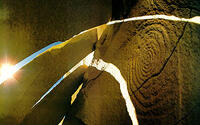 We will not address the question Why this happened but it is clear that recorded history of mankind indicates a deep understanding of the crucial impact of the Sun (light) in the form of solar deities or other supernatural fenomenon,
rituals, sacrifices, calendars (Sun dials), monuments, poems, plays, music, movies etc. It might be useful to get a more personal and intimate understanding of light combined with some scientific knowledge.
We will not address the question Why this happened but it is clear that recorded history of mankind indicates a deep understanding of the crucial impact of the Sun (light) in the form of solar deities or other supernatural fenomenon,
rituals, sacrifices, calendars (Sun dials), monuments, poems, plays, music, movies etc. It might be useful to get a more personal and intimate understanding of light combined with some scientific knowledge.
The Sun, the hearth of affection and life, pours burning love on the delighted earth. Arthur Rimbaud (1854-1891)
SunAware Exercises
Before looking at some science based information about the Sun light and its conversion into electricity it might be interesting to introduce some Sun-awareness-building exercises to sharpen the senses like a pencil in a Planetary Pencil Pointer.

Rules: Observation only; no rationalizing, comparing nor describing. Do not look longer into the Sun than 100sec.
Recommended conditions: perform the exercises on your own in a distraction free environment. Do them repeatedly in each season in the morning, at noon, dusk and evening. Except for exercise 9, 10, 12-14 the sun does not necessarily have to be visible.
- Inti-mate
1.Close your eyes as tight as possible. Turn your head towards the spot where you observe the most light. Then gradually, very, very slowly open up your eyes. Try to keep them open as long as possible (don't try too hard) and then close them instantly and fiercely. Observe what you see.
2.Breath in and out through your nostrils at a natural pace. Observe what you smell.
3.Take out as many clothes as possible. Close your eyes and scan your body gradually, slowly from the top to the bottom. Observe the sensations on your skin.
4.Breath in through your mouth at out through your nose. Observe the sensations, the taste on your lips and in your mouth. Observe how it travels through your body. If and how it leaves it.
5.Focus on what you hear. Try to listen to the sounds of the light.
- Engaged
6. Close your eyes in a natural way and turn your head towards the spot with the highest light intensity. Wave with both hands, fingers tightly pressed, in front of your eyes in opposite directions (L-hand from left to right and back; R-hand from right to left and back). Repeat but open your fingers as far as you can. Observe.
7. Stand up, close your eyes in a natural way and turn your body towards the spot with the highest light intensity. Start rotating counterclockwise -pivot around your left foot- at a slow/moderate pace. Observe. After a couple rotations gradually slow the rotation speed down, following the natural echo of your movement. Do not stop abruptly and do not start turning in the opposite direction.
- With the help of some tools
8. Take one or more mirrors. Look for the darkest place in your immediate surrounding. Use the mirror to transport the light towards this dark spot and make it lighter.
9. Take or make an object -preferably so that it can rotate- and hang it between the wall and the sun light. Make the object and observe the wall.
10. Track the Sun movement using scotch tape and a meter. Indicate every hour the position of the shade. Measure the distance between two following marks.
- Outdoors
11. Go outside and use your meter to measure the distance from the Earth's surface to the Sun.
12. Take the train, tram or tandem on a bright day. Close your eyes in a natural way and turn your head towards the spot with the highest light intensity. Observe the back of your eyes. For this exercise it is recommended to look for a trajectory aligned with trees.
13. Take the train, tram or tandem with motorcycle helmet when the sun has just succeeded the rain. Take a seat a the sunny-side. Look through a rain drop, and another one, and… another one. Observe.
14. On a sunny day Look for a river, lake or even better a sea. Scan the water surface for the place with the highest light intensity. Focus and observe.
Note: Exercise 1-8 can be repeated with artificial light.
After the seventh SunAware exercise -hence after having seen the light, felt it, heard it, tasted and scent it, tracked it like a leaf, now thinking about it as being a nano-drop of air <.> or a hot air wave <~> in the sea of light, you have become deeply connected with the photovoltaic effect and the essence of photovoltaic cells. In fact as a human being we are to a certain extend a pv-cell as we absorb, reflect, and transform light and emit infrared radiation heat instead of electricity.
After our own observations we can take a closer -but not in depth- look at what the scientific world has to say about the light and radiation of the star called Sun.
SunAware Science
All life on earth is ultimately solar powered and this energy is the invisible means of exchange on which all science is based. If energy is the essence of our existence than power is the extent to which useful energy is flowing. For every life form energy is needed and sufficient power to keep the flow of energy going. In the combination men, intelligence, energy, it's the source of energy, and not human inspiration that ultimately is the limiting factor for human progress. The struggle for survival in between organisms ans with others is a fight for conquering useful energy and to assure the flow of energy through these living systems. (p.51 Rifkin NL)
“If you want to understand a Microcosm, attach yourself to the Macrocosm” -Goethe
Solar radiance
It all began 5 billion years ago when gravity pulled in a cloud of cosmic rubble, at the core getting denser and hotter, gas and dust fused together comets streaked towards the newborn sun. The same process is going on all across the sky. Our Sun is just one of a million stars. Stars born out of other stars.
“We drift through the universe…”; ”…pushed on by the solar winds“; “From planet to planet…” - Leonard Nimoy from the film Invasion Of The Body Snatchers
The hot surface of the Sun radiates electromagnetic energy that spans the entire spectrum. The intensity of the light is greatest in the visible portion of the spectrum and the warmth we feel on a sunny day is due to the absorption of the infrared radiation. That warmth is energy. Conventional solar power uses that energy to heat water. The photovoltaic (solar) cells convert electromagnetic energy directly into electrical energy. It does not have to be a hot day. All we need is light. Source: http://cs.sbcc.edu/physics/solar/sciencesegment

The electromagnetic (EM) spectrum is just a name that scientists give a bunch of types of radiation when they want to talk about them as a group. Radiation is energy that travels and spreads out as it goes– visible light that comes from a lamp in your house or radio waves that come from a radio station are two types of electromagnetic radiation. Other examples of EM radiation are microwaves, infrared and ultraviolet light, X-rays and gamma-rays. Hotter, more energetic objects and events create higher energy radiation than cool objects. Only extremely hot objects or particles moving at very high velocities can create high-energy radiation like X-rays and gamma-rays. More on EM: http://imagine.gsfc.nasa.gov/docs/science/know_l1/emspectrum.html
Taking a closer look at the nature of the energy reaching us from our biggest and oldest source of energy, there is one very important observations (and advantage): the Sun's energy is traveling towards the Earth; it comes to us.
A ray of light consists of a stream of photons -tiny packets of light energy- moving along at around 300,000km/sec. At this speed the voyage takes only 8,5 minutes. In other words, the natural light you are seeing right now has been born 8'5 minutes ago.
Energy output
The total output of the Sun is 4x1026W. The intensity outside the Earth's atmosphere is 1367 W/m² The power reaching Earth is 1,78x10¹⁷W. (1,700 kWh/m²/year)
This is enough to: - provide for annual global energy consumption 10,000 times over. - produce an average 1,700 kWh of power annually on each square meter of land.
Planet earth is just at the right distance from the Sun but the greater the available solar resource at a given location the larger the quantity of electricity generated. Tropical regions offer a better resource than more temperate latitudes. The average irradiation in Europe is about 1,000 kWh per square meter, for example, compared with 1,800 kWh in the Middle East.
Sun Model
The Sun vibrates up and down, in and out, much like a pot of fudge boiling on the stove. When you make fudge, you can see large bubbles of chocolate covering the pan. And, in each of those big bubbles you can also see a set of tiny bubbles growing and popping with gusto. The Sun is the same. When you look at the following movies, you are viewing the large scale (big bubble) oscillations (the small ones would be too tiny to see). Images of the Sun via the SOHO satelite.
Sun Song
Have you ever wondered what the Sun would sound like if you could hear it? Sound won't travel through space, but with the right instrument, scientists can “hear” pulsations from the Sun. The entire Sun vibrates from a complex pattern of acoustical waves, much like a bell. If your eyes were sharp enough, you could see a bell's surface jiggle in complex patterns as the waves bounced around within it. Likewise, astronomers at Stanford University can record acoustical pressure waves in the Sun by carefully tracking movements on the Sun's surface. To do this, they use an instrument called a Michelson Doppler Imager (MDI), mounted on the SOHO spacecraft, circling the Sun 1,000,000 miles from Earth. The Sun's acoustical waves bounce from one side of the Sun to the other in about two hours, causing the Sun's surface to oscillate, or wiggle up and down. Because these sound waves travel underneath the Sun's surface, they are influenced by conditions inside the Sun. So scientists can use the oscillations to learn more about how the structure of the Sun's interior shapes its surface. The Sun's sound waves are normally at frequencies too low for the human ear to hear. To be able to hear them, the scientists sped up the waves 42,000 times – and compressed 40 days of vibrations into a few seconds. What you'll be hearing are just a few dozen of the 10 million resonances echoing inside the Sun. See: http://quake.stanford.edu/~sasha/SOUNDS/sounds.html
Links
More Sun observation practices: http://hea-www.harvard.edu/ECT/the_book/Chap1/Chapter1.html
Sun Physics by Nasa: http://solarscience.msfc.nasa.gov
Wikipedia: http://en.wikipedia.org/wiki/Sun
Fusionanomaly: http://fusionanomaly.net/sun.html
Solar Folklore: http://solar-center.stanford.edu/folklore/folklore.html
Solstice: http://www.solsticeproject.org\
Photovoltaics
Photovoltaics (PV) is the direct conversion of light into electricity at the atomic level. The word refers both to the science and the technology, which are based on the photovoltaic effect: the generation of a voltage and/or a current, by absorption of light in some material or a combination of materials. Electricity that can be used for immediate power -Direct PV Systems- or delayed, with the help of storage technologies. In PV these elements are interconnected by various sciences: (quantum)physics, optics, (bio-)chemistry, engineering, materials science and micro-electronics.
The photovoltaic effect is first observed in 1839 by A.E. Becquerel, a French physicist. The first functional, intentionally made PV device is from American inventor Charles Fritts in 1883 with an efficiency of 0,1 percent. The modern era of PV starts in 1954 when Bell Labs in the USA produces a 6 percent efficient solar cell using silicon as a semiconductor.
Five years later the Sputnik 3 is the first satellite using solar arrays, followed by Vanguard I for powering a small radio transistor. A major visual proof for the world that the Sun's energy can be harvested to generate electrical energy. 
“Light - a mysterious element that enables people to command nature.” Sir Francis Bacon, New Atlantis (1627)
A second hallmark for PV arrives in 1973, when the global petrol crises turns the noses of petrol depending states and energy companies towards renewable energy and especially PV: US-president Carter puts PV-panels on the roof of the White House. …Only to be removed by Ronald Reagan in the slipstream of the oil crisis. Furthermore, when PV-rerearch and development face scale-up problems, budgets are drastically cut or cancelled, causing the loss of years of powerful brain power. In the eighties and nineties, with the help of consumer devices like the solar powered calculator, -wrist watch, -outdoor lighting and other novel consumer applications, Japanese, US and European companies continue to develop power modules, mainly for the building industries and for stand alone systems in remote areas.
In the 21st century, supportive government policies in many European countries and Japan, -partly driven by the Kyoto Protocol, Climate change and especially the steep rise of oil prices in 2007/08- result in a substantial increase in production. Most of the big manufacturers are either divisions or subsidiaries of large companies with diverse manufacturing interests (Sharp/BP/Shell/Kyocera). Most of the research for advanced future technologies takes place in academic and privately owned research centers. The role of PV-power in the world's overall energy system is still negligible -less than 0.5 percent- with predictions by the industries and environmental organizations that it could rise to 26% by 2040.
“The environmental impact of PV is probably lower than that of any other renewable or non-renewable electricity generating system.” - IMEC Research Center – Leuven [BE]
Photon Power for Art
The strong vibrations in the rapidly expanding field of photovoltaics are increasingly being picked up by the global arts community. Since the beginning of the 21st century more artists engage and experiment with different kinds of solar cells and panels. Partly because of the technology becoming more efficient and more readily available at affordable prices. Partly because of the intrinsic qualities of the technology which when in use is silent, emission free, portable, durable and functioning as a power generator and/or a light sensing device.

But especially new designs, materials, structures and shapes have augmented the interest of creatives. The 'classic' rigid blue/grey/brown silicon-based cells are gradually joined by thin-rigid or thin-flexible organic PV cells of various colors and shapes. This means that the integration with more materials is possible, opening the way to new functions and aesthetics. These recent innovations in PV-technology are particularly fused by advances in nano-sciences, allowing PV to enter the realm of soft materials (SMPV) bringing it closer to the body, into the realm of the intimate. The energy demand of portable devices is now low enough that clothing-integrated solar cells are able to power most mobile electronics. Military textile designers are trying to overcome integration problems by developing PV-fibers that can be used for producing woven PV-textiles.
Nevertheless, the more versatile, aesthetically interesting cells like the polymer and dye sensitized solar cells are still less efficient (max 10%) and durable (<3 years) than the classic Silicon cells with efficiencies over 16% and an expected life span of 20 years and more. Also, the integration of flexible polymer (or other chemicals)-based PV with electronic consumer goods, solarbots and textiles raises environmental concerns. These are limited life span products that rapidly become a wide-spread new kind of e-waste, requiring new recycling schemes.
Appropriating PV > Natural Dye Sensitized Solar Cells
DIY-ing traditional silicon-PV-cells is fairly possible with extensive documentation online and with the necessary tools and materials readily available. The materials involved require a lot of 'heat, beat and treat', so it is worthwhile looking for used or recycled panels -a rapidly expanding market with as the first generation of PV-panels is reaching it's end (with the Si-cells still functioning). Or one can try to interconnect different parts of broken 'scrap' cells, requiring especially steady hands and a patient tranquil mind.

Often PV-tech is compared with the plant leaf's capacity of harvesting the Sun's energy. But there is only one type of PV-cell that mimics significantly the natural process of photosynthesis: the natural Dye Sensitized Solar Cells (nDSC). It is made of the dyes of anthocyanin or carotenoid-rich fruits like berries, currants, black beans etc., some titanium-dioxide (cf. white paint, toothpaste) some graphite or carbon and an electrolyte, all sandwiched between two tiny conductive (tin-oxide) glass plates. Easy to DIY in the kitchen with components available online, on the balcony, in the garden, the park and the street. Unsurprisingly the plants that produce the energetic nDSC-dyes are very popular amongst the bees.
“It is the role of the artist to comment on the way society is dealing with Energy.” Ai Wei Wei. “Fuck Off” exhibition, 2000 [Shanghai, CH]
One of the main challenges of the nDSSC is the liquid electrolyte, that does not exactly contribute to the already challenging life expectancy of the cells. Therefore researchers are looking for (quasi) solid state electrolytes > some papers (abstracts)
In Bartaku experiments -looking at sustainable electrolytes- human tears were extracted from a female. Due to harvesting issues the experiment could not be executed. Also, the right mood / trigger has to be applied in order to extract the right type of tears with the potentially most ionized salt complex. In the Temporary Digestopians Labs, tests will be done -if a co-creator can be motivated- to make a solid gelatin (agar agar) based electrolyte with an anti-diarrhea salt solution readily available at the local pharmacy.
Temporary photoElectric Digestopians
temporary PhotoElectric Digestopians Worklab Series

Co-creation experimentations with Bartaku on intimate sunelectric taste and representation of the eternal struggle for access to energy. The tPED Worklabs series are based on the first observation of the e-tickle on the tongue on October 21st, 2010, at Bartaku's homelab. They consist of experimentations on the transformation of light energy into electric energy with food. By fusing alchemistry, cooking and solar tech and designs, the co-creators will work with edible materials to create 'e-bites' with different aesthetics, tastes, consistencies and smells. To be tested, tasted and appreciated on heliotropic tickling tongues.
Initially, how it started Building further upon the nDSC to explore ways to express the transformation of energy from light over plants, the(ir) food; the body.
Temporary photoElectric Digestopians: e-pastry, e-sushi… for heliotropic tasting towards tickling tongues and enriched tastes.
TpED Worklab 1 First collective experiments during “Worklab 'Temporary photoElectric Digestopians - Experiments with photovoltaics and food.' Tactile Research Lab of the Artscience Interfaculty, Royal Academy of Fine Arts, The Hague (Hol). Nov. 8, 010” See: - flickr - cocky eek's lab blog
Participation
- No pre-existing knowledge required.
- Max. nr. of participants: 16
- Duration: 3hrs
- Cost per person (materials): max. 10Eur
Basic Tech Design _v1
iterative 'growth' path
“Sandwich Design”
== Top Transparent Insulator == → Glass OR → Gel(atin)
== Photo Electrode == → Conductive textile thread OR → Edible silver
== Electron Receptor == → Titaniumdioxide (TiO2)
== Natural Dye == → Vegetable juice AND OR → Fruit juice → Flower juice
== Electrolyte == → Lemon OR → Baking Soda+Lo-Salt+White vinegar OR → Sports Power Drink OR → Children's Anti-diarrhea drink OR Tears (tbc)
== Catalyst == → Carbon from Bees Wax candle OR → Graphite
== Counter Electrode == → Conductive textile thread OR → Edible silver
== Bottom Insulator == → Glass OR → Gel(atin) OR → Cookie/Biscuit/Cracker OR → Cheese OR …
== Conservation == → Edible Paper Wrap
Iterations on jelly making dd. 012711
A
1/ preparing with dyes added afterwards a. leave to dry and add TiO2 b. mix TiO2 with dye
2/ prepare with dyes mixed into the water
3/ prepare with Agar in pure dye
B Sugar: add Sugar to one of the above
C Experiment with Gel Electrolyte
Materials List
Edibles
- vegetables/fruits high in (a) anthocyanin- or (b) carotenoid pigments
a) berries, currants, purple corn (cob), blood orange, red cabbage, red ognons (peel), hibiscus (leafs), black tea (leafs), beetroot, pomegranate;
b) carrots, pumpkin, spinach, sweet potatoes, squash, pumpkins, orange bell peppers, apricots, cantaloupe, papaya, corn, yellow squash and yellow bell peppers, tomatoes, red bell peppers, radishes and watermelon
- edible silver
- electrolytes (lemon; baking soda; vinegar; sea (low)salt)
- conductive thread
- gelatines (agar agar; gellan)
- powder sugar (non-starch)
- beewax candle: 2
- (alpha lipoic acid)
- (Gold Leaf)
- hard cakes/crackers (eg. casave) for bottom layer
Tools
- seringes
- food clamps
- scissors, sharp
- cooking stove
- 4 pots/pans; foam scoop
- electric water cooker
- high sensitive kitchen scale
- food thermometer
- lamp+bulb (min. 60W)
- coffee filter & recipient
- recipients for jelly
- multimeter
- measure pot (transparent)
- a dozen of small jars/pots with lid to store the liquids
Infrastructural Requirements
- 8 small and 2 big tables
- 16 chairs
- sink+water
- electricity
WorkLab One issues/Observations
- at least 3 hours (16p) needed for whole process (jelly's made the day before) - materials table with labels required - difficult to cut the silver sheets in thin stripes (electrodes)
Second WorkLab issues/Observations
- Pre-colored Agar Agar contains synthetic colorants that are forbidden in some countries due to unwanted side effects with children (hyperactivity), asthmatics… (cf. E-numbers food colorants - Duration for making one TpED (2p; premade jelly): 2hrs - Best result with Agar Agar (brand: Lima; scoop of the foam) - Look for Edible Gold Sheets - DIY BeeWaxCandle - Making of Edible Silver Sheets: tiny paint brush, wetted with tongue, is placed on the sheets and moved onto a sheet of (news)paper. A craft in itself. - Still unclear how to best cut the silver sheets in thin stripes (electrodes). Best till know is cissors. [with special Tx to Franky DC]. And a bit later -thx to x., the best method is putting the required piece of silver between two sheets of paper, cut, and place where needed. - Capturing from candle and depositing needs improvement - Better tools needed for handling the jellys
interview with Bartaku at Burning Ice / Changing Tents in Brussels, Jan.20, 2011.
New Ways with Rays
Deciding to use PV-cells for powering the electric devices of an artistic project has an impact on various levels: from the time and space of use, the choice of materials and components to the design and appearance, the relation with the user/audience and the budget. Working with PV most definitely puts the energy-aspect much higher in the project's priorities list.
When and where is light
Unless one does not want to make use of the fabulous opportunity to get freed from the plug, a PV-arts project might be an indoor but mainly outdoor 'autonomous' or 'stand-alone'-system. The first issue in the latter concerns the intermittent nature of the solar radiation, the ambient light intensity. Natural light is available only during the day -at varying angles according to the time of year- and strongly reduced in overcast skies. Consequently one has to decide when the energy is needed: 24hrs per day during a week in november? Or at noon only, for five minutes, every day in summer… Or maybe visiting hours have to coincide with the hours of direct Sun light.
This decision will highly determine the choice of the system design: a direct PV-stand alone system, PV-Pur Sang, with PV-cells providing electricity instantly to the Rotor, vibrator or LED-lights that respond immediately, demonstrating the flux of the qualities of light; or a stand alone system including an energy storage system for the moments when energy is needed but not guaranteed by natural light. Obviously the geographic location of the project in itself determines the amount of PV-cells needed since the solar radiation on the planet varies greatly.
“Everything is relative” - Albert Einstein
“The speed of light is not relative” - Albert Einstein
Some PV-cells perform under artificial light conditions, so the work can be placed indoors, nearby some well chosen lighting devices. The better the match between the PV-cells and the lamps' spectrum and the more optimal the distance between them, the more power is generated and the lesser cells and lamps are needed for the same output.
Optical tools & tricks
There are more 'tricks' to make the process the most efficient and as cost-effective as possible. One cell is connected to others to create a panel and interconnected panels constitute an array producing more volts or amps. In case the Sun is shining but not reaching the PV-cell, Archimedes' 'Heat Ray' demonstrated that mirrors can transport light for more and bigger Suns. More power is also obtained by placing a fresnel concentrating lens between the light source and a PV-cell. Or one can follow the Sun's path with the help of a solar tracker: PV-cell and panels mounted on rotating 'feet', hereby imitating the movement of heliotropic plants. In Western-Europe 30” is generally the best angle for the PV-cell's best Photon-catch.
Energy storage and AC/DC
In case there is no -or an insufficient amount of- natural light, one may consider to create a hybrid system, for example using a PV-panel and a wind turbine in wind rich areas. Still, it might be necessary to integrate an energy back up system consisting of a storage device like a battery or supercapacitor, a charge controller, a DC-DC or DC-AC inverter which is set up in between the PV-panel and the appliances. The battery can also store electrical energy in case there is production excess. But the system becomes more complex, more vulnerable, more expensive and above all, much less sustainable.
Plant Power for PV
Information about plants that are interesting for the production of natural dye sensitized solar cells, including Temporary photoElectric Digestopians such as energy and efficiency values for body and solar cell; growth information etc.
The natural dye based DSC-technology expresses the strong connection between food energy (in kiloJoules) and electrical energy (power, in Watts):
1kWh equals 3600 kiloJoules OR 3,6 Joules = 1 Wh
First experiments show that the higher the kJ-value of the juice from a power plant, the more electrical energy is provided when the juice is used in a nDsc-design.
Fruits with the highest energy rates like the Chokeberries, Hippophae berries, Cranberries, Black Currants etc. are beneficial for human health as they contain high concentrations of anti-oxidants.
Update March 2011, Oaxaca (Mex): till know focus was on fruits/plants with high amounts of anthocyanin and carotenoid pigments. Research in 2011 has shown that the vast collection can be broadened up towards flora that contain betalains such as the Bougainvillea flowers (spectabilis and glabra). In Mexico the flower is used for tea as a remedy for coughs, or as part of a tea with mainly Evening Primrose (Oenothera rose Ait., hierba de golpe) and some cinnamon, used as a cure for anger, injuries from being struck, and coughs (http://www.arts.ualberta.ca/%7Etotonaco/Plants.html). (ndssc research in mexico)
The Betalain pigments are also found in prickly pear (Opuntia spp.) fruit, also known as tuna in Mexico and nochtli in the Nahuatl language. It is one of the most representative fruits in Mexican culture and has recently gained attention for its nutritional and potential technological values. Evidences of its use have existed for more than 9000 years. Opuntia plants are characterized as tolerant to varied soils, temperatures, and moisture levels. Approximately 200 species are known in the world, and Mexico possesses a great genetic variability, with a diversity of fruit pulp tonalities (red, white, and yellow) and with a wide harvesting period including fruits of early (May), intermediate (August) and late maturation (November). Opuntia plantations have previously been exploited for cochineal production. (In: J. Agric. Food Chem. 2008, 56, 5758–5764. (pdf)
Surprisingly -or yet not so- especially these plants are extremely popular amongst pollinators, esp. the bees. Therefore it is recommended to have a hive nearby the Spiradye; good for plants, biodiversity, electrical and other energies.
Power Plant Growth
- Reflections/interventions on the production of power plants, esp. in the urban realm. Tool: Spiradye: a permaculture based spiral construction that can host plants -with optimized use of space.
SpiraDye I [okno openGreen roofgarden. Bru/BE, 2009- ]
The Coders' Disbelief - “Harvest or Collapse”
The Story: Harvest before Collapse: One Strawberry in May. Destination: an anti-oxidant rich Special Delicate Gift
Materials: 154 discarded cardboard pipes from the infamous brussels arab brabant shopping street; collected just before closing time and transported by bike.
Soil: gravel (2/3) + compost and straw
Status: Feb 2011: a dozen left-over pipes
Status August 2011: very actively accupied left over spiral with planned and unplanned plants.
Status Feb 2012: 5 left over pipes & rumours that the left over spiral will be removed.
SpiraDye II [The Ever Wasteland. Bru/BE, 2009- ]
Materials: unearthed belgian red bricks; debris from a rubbish container from the house next door.
Soil: local soil (1/3) compost (2/3) straw
Status: From Wasteland to Borderland: cut in half by a fence (H=2m), May 2010
Status Feb 2011: chicken appeared on one side of the fence, 2 beehives on the other.
Status Aug. 2011: all the plants eaten by presumably the chicken. Moroccan spinach next to the hives.
Seven Plants, changed plans In the rather slow building process of the Spiradye II (due to slow deconstruction of the house next door), the plant spiral became the host of unplanned plant life, before the planned plants were planted. The former were welcomed, the latter were integrated elsewhere in 'The Ever Mass Land' [Bru/BE].
Nutritional value: kJ/100gr - Electric Energy Value: Wh (100gr) - DS-Cell output (1 cell=8m2): Watts (Volts x Current)
Hippophae Rhamnoides – Duindoorn/ Argousier / Hippophae Berry [Protected plant] 432 kJ / 100gr - 117,5 Wh - ,015W
Vaccinium Myrtillus – Blauwe Bosbes / Small Cranberry / Myrtille 361 kJ / 100gr - 100,27 Wh - ,0175W
Ribes Nigrum – Zwarte aalbes / Black Currant / noir 202 kJ / 100gr - 56,1 Wh - 0,02W
Ribes Rubrum – Rode aalbes / Red Currant / Grosseillier rouge 159 kJ / 100gr - 44,16 Wh - 0,005W
Fragaria Ostara – Aardbei / Strawberry / Fraise (✝) 135 kJ / 100gr - 37,5 Wh - 0,005W
Rubus Idaeus – Framboos/ Red Raspberry / Framboisier 130 kJ / 100gr - 36,1 Wh - 0,005W
Vaccinium Vitis Idaea - Rode Bosbes/ Alpine Cranberry / Airelle Rouge 116 kJ / 100gr - 32,2 Wh - 0,005W
Links
http://nadine.be/wasteland/the-ever-wasteland/the-ever-wasteland
http://www.flickr.com/photos/phoef/sets/72157625628887069/
Beehive: http://www.apiary.be/index.php?/projects/bzzz---bees-in-urban-spaces/
A Slow Flow [Guwahati, India 2009/10- ]
“The climate of the valley had such influence that, here life goes very slowly, whoever settles down in this valley in a span of fifty years, he had to slow down his pace.” Sir Edward Gait. The History of Assam (1881) - In: Brahmananda Patiri, Ananta Borah (2007).
On the map it is a straight line, from the Zoo-cum-Botanical Garden over the Ghandi Mandap to the Periferry.
Immobilized, squeezed between two other vessels, one wonders if the Periferry is actually carried by the river. In the transition time of years, period of fuzzy Suns, the Brahmaputra leaves a fertile dirt track behind in its annual retreat. He demonstrates a slow flow, disguising himself as a tamed stream with a modernist past.
Immobilized anyways due to the price of petrol, Periferry functions merely as a transition place between the South-Bank and the stand-by double-engine rescue boat as well as a chat-room for the stand-by crew. Many other boats are lining the bank, randomly, rusty, awaiting to be reshaped, re-used, or dismantled, buried.
These icons of the industrialized petrol powered era share their uncertain future with the powerful Brahmaputra, with both its water and its power that are most wanted by states, industries, people.
Observations that lead to ancient questions about access to energy. Questions that lead to new competitions over matter and mind, air, land, water and, not unimaginable- light. Oscillations that cover more than ever a global digitized dimension.
“Hah. Twenty. You take twenty two itself. Don't make it less. Twenty two twenty three, twenty five you take, twenty five, ‘pachis’ (laughter).”
Twenty two, twenty three.”
“””’Tiga’ sir.““” [Says the man with the say over the river’s left-over soil]
[Some women and young boys are shouting whilst trying to keep their balance under the too heavy load of vegetables, reaching the bank from the boat that came downstream].
“”We have to put the spiral on top?””
He knows.
[Wiping off hands whilst people on boat talk Assamese]
Work In Progress Dialogue, Jan. 28, 010 > Brahmaputra South-Bank, Uzanbazar, Guwahati (Assam, N-East, India).
A Slow Flow > Site specific installation & workshop at Periferry 1.0 - Brahmaputra/Guwahati, Assam, India - Feb. 14&15, 2010. Made during a residency periferry_-_residency_bartaku_-_preliminaries.pdf
- Periferry 1.0 is an initiative of artist collective Desire Machine Collective > See Blog
Some picts on Flickr
Video, part of installation: Heliotropic Earcleaning
Status Sept 2011: plantful bamboo spiral next (above) the city boulevard
Aronia Melanocarpa Plant Guild
Companion Plants Starting point: observation on former kolchoze, aronia plantation in aizpute (latvia) Composition analysis in function of use in nDSC - based on http://www.liberherbarum.com/
* Common Valerian - Valeriaan - Valeriana officinalis
Pigment
The root contains various metals: selenium, tin, calcium, magnesium, manganese, chromium, potassium, iron, zinc (all 5percent) and Sodium - Silicium
* Marigolds - Goudsbloem - Calendula officinalis > http://www.liberherbarum.com/Pn0111.HTM
Pigment: Carotenoid: 42percent
Note: considered a noxious invasive plant in many localities > (http://en.wikipedia.org/wiki/Marigold_(common) The marigolds you choose must be a scented variety for them to work. One down side is that marigolds do attract spider mites and slugs. French Marigold (T. Patula) has roots that exude a substance which spreads in their immediate vicinity killing nematodes.
* Nasturtium - Oost-Indische kers - Tropaeolum Majus One year-Creeper; native to South-America. They were brought to Spain in the 1500's and later introduced in Europe. Next to fruit trees/bush it keeps leaf lice away.
* White clover - Witte klaver - Trifolium Repens
* Blueberry - Blauwe bosbes - Vaccinium Myrtillus
* Bird vetchlings - The Meadow Vetchling Milk Vetch - Wilde hokjespeul - Astragalus glycyphyllos (fam.: Leguminosae)
All species with edible seedpods can be distinguished by their fleshy round or oval seedpod that looks somewhat like a greengage. A number of species can also accumulate toxic levels of selenium when grown in soils that are relatively rich in that element (www.pfaf.org): vetch can concentrate up to 1.4% of its weight as selenium on these soils. Marco Polo (1254-1324) wrote that the animals of Turkestan behaved like the so-called 'blind staggers. The cowboys of the Wild West knew that this plant could affect their herds, and called it 'locoweed' (insane). The term usually refers also to another North American species: Oxytropis (producing another locoweed-toxin called swainsonine). In 1934 biochemist Orville Beath proved that the staggers were caused by excess selenium in the diet. When the vetch has an offensive smell, it is a sure indication that it has absorbed a high level of selenium.
Selenium is rarer than silver, and one day mineral sources of the element will be exhausted. Then we may have to harvest it by growing crops like milk vetch (3kg/acre). The current (1996 - UPDATE needed) world demand The metallic form of selenium generates an electric current when light falls on its surface, and for these electronic properties -requiring high grade selenium of 99.9% purity and accounting for a third of the production, it is used in PV-cells, light meters and photocopiers. The seconc largest user is the glass industry (Sun-ray blocking) and the third main use is to make sodium selenite for animal feeds and food supplements. Selenium is also used in metal alloys like lead plates in batteries; ac-dc rectifiers/convertors and in… anti-dandruff shampoos (Emsley, 23).
* Dandelion - Paardebloem - Taraxacum officinale
* Daucus Carota - Wilde wortel - Wild carrot
any other plant of the family can do: “The Apiaceae or Umbelliferae - family of usually aromatic plants with hollow stems, commonly known as umbellifers. Almost every widely cultivated plant of this group is a companion plant.”
Note: observations at former aizpute kolchoze in aug. 2010 → Edible plants Bird (Tufted/Cow) vetch - Vogelwikke - Vicia cracca (seeds); Perennial; Growth Habit: Vine, Forb/herb; more Black chokeberry – Aronia Melanocarpa (Photinia melanocarpa) (Michx.) elliot / Rosaceae Blueberries, wild - Vaccinium corymbosum Meadow vetchling - Veldlathyrus - Lathyrus pratensis (seeds) Parsnip – Pastinaak - Pastinaca sativa Valerian - Valeriaan Valeriana officinalis
About the Tufted/bird/cow vetch
cascading pea-flower shaped purple to violet flowers (purple)
Tufted Vetch is widely used as a forage crop for cattle, and is beneficial to other plants because, like other leguminous plants, it enriches the soil in which it grows by its nitrogen-fixing properties. Tufted Vetch is also much appreciated by bees and butterflies as a source of nectar. The plant may also be used to curb erosion.
Aronia M. A stand-by power plant in intermediary times
Just outside of the village in a westbound former part of a mighty centralized East. Over one hundred Aronia B.Melanocarpa [(Michx.)Elliot] power plants, dispersed on allotment “Number Six Four Seven, Two Zero Zero. Eight Zero Zero, Seven Two”. Originating from folded, deep brown seeds that crossed the ocean in a tiny box from West to East, before the great wars.
Mr. Vavilov meets Antoinette again. He collected seeds for his seed bank, in the North-East of America -in swamps and low woodlands from Nova Scotia to Ontario, to Florida and Michigan. The countess travels back to Europe as well, to her tiny island-cum-botanical garden on the grand mountain lake that unites and separates two countries. Then, looking over her shoulder at the black swirling ghost that returns to his chimney, he tells her hat the seeds Aronia M. ripen from October till December. - (A possible encounter on the Atlantic Ocean in 1921)
Passing the last wooden house of the village, where the road turns slightly right, the side arm on the left separates apple trees from the Aronia M. bushes. The long but narrow black coating is suffering from zigzagged scars made by ants that reclaim the land with support of sturdy spiky grasses. A blue print for land use throughout the mighty Union until it scattered into tiny new and old constellations.
For decades Aronia B.M. received the fast moving hands of schoolboys and -girls in the first weeks of September. The release after four moons from green to bold red leaves; from white flowers to a green dot of fruit, to a berry with a blue-to-black tight skin with the powerful essence that compresses it's subordinate astringent sap. Fourteen days of joyful picking nearby the apple trees, extending the summer holidays. From nine to three in rows and columns, from one side to the other and back. One basket two children, most berries are easy to reach. Honor to the boys and girls that fill the woven baskets with pure single berries -no cheating with branches or newspaper. One jar they take home, often to make wine.
'Last autumn I was thinking to plant few Aronia M.'s also in my garden. Although in childhood I hated these berries because of the strange taste. My grandmother had them and she used to tell me so often that 'They are very healthy. Try one!' - Signe Pucena – Aizpute (Latvia), 2010
The next day the village is stained with a deep dark black-blue. Them-and-us-children gathered after three, sneaked into gardens, and removed the plastic pipes that are used to span the plastic cover of the reverse-U-shaped green houses. Equipped with these blow pipes they roamed the village, trying to blow the enemy away with the 'berrybullets'. In no time the walls of the village houses were full of dark stains, including Lenin's statue.
From the basket to the shed, to the nearby juice-, jam-, syrup-, dye- and wine making factories most of the berries are moved. The allotment owner brings the left overs to the port to ship them further, in North-West direction. In exchange the North-West sends a container with most wanted warm cloths for the cold winters. The central state lottery makes the same everybody happy and the same everybody less happy, year after year.
'They just grow. There is no one who would weed it, no one to water it, to cut it. Nothing.' Agita Kemere - Aizpute (Latvia), 2010
Allotment 'Number 6 4 7 Two 0 0 8 0 0 Seven 2'. Hundreds of old sturdy wrinkly Aronia M. bushes, interconnected with their next and future generation. The echo's of the children's footsteps on the dry end-of-summer-soil interweave with the roots of Aronia M. bushes and shoots, Blueberries, Bird- and meadow vetchlings, Valerians, Parsnips and wild grasses up to a thigh-high.
'Grasses have overtaken!' - Ossi Kakko – Former A.M-Kolchoze, Aizpute (Latvia), 2010

'You can take more”, Ance Zemžāne says. 'I think nobody really needs them out here, no one is picking them any more and for that reason it is so wild. In Latvia -with this kind of heritage- it is really kind of sad. Because we have huge apple tree gardens as well here. Really really huge. And if nobody takes care of them, then there are no good fruits afterwards. Nobody picks them up. Nobody cuts the branches. And it is the same for Aronia. The grasses take over. And as you said, this is really useful stuff.'
In intermediary times Aronia M. reflects a too recent undigested past- undergoing neglect and reject by local bodies. But self-assured, with grace and with class, he reaches out for a global future that will refresh its status as a premium power plant for the body and the electric.
Bartaku february 9, 2011 – draft version
Based on research during Herbologies 2010, Aizpute, Kurzeme Region (LAT) > http://www.pixelache.ac/helsinki/herbologies-foraging-networks/herbologies-expedition-kurzeme/ About N.I. Vavilov Research Institute of Plant Industry > http://www.vir.nw.ru/index.htm Photograph by Wojtek Mejor
Resources
Literature Aronia
Brand M. (2009) Aronia: native shrubs with untapped potential. Arnoldia 67(3): 14-25. [available online at: http://arnoldia.arboretum.harvard.edu/pdf/articles/2010-67-3-aronia-native-shrubs-with-untapped-potential.pdf
De Jong P.S. & Hop M.E.C.M. (1994) Aronia. Dendroflora 31: 24-28.
De Koning J., Van den Broek J.W., Van de Laar H.J. & Fortgens G. (2000) Nederlandse dendrologie (13e druk). H. Veenman & zonen, Ede: 585 p.
Hardin H. (1973) The enigmatic ckokeberries. Bull. Torrey Bot. Club 100(3): 178-184.
Hop M.E.C.M. (1999) Aronia – Appelbes (deel 2). Dendroflora 36: 40-47. [available online at: https://www.researchgate.net/publication/40108239_Aronia_appelbes_deel_2]
Hop M.E.C.M. (2014-2015) Aronia – Appelbes, deel 3. Dendroflora 51: 24-33.
Knees S.G. (1995) Aronia. In: Cullen J. & al. (eds.), The European Garden Flora, vol. 4. Cambridge University Press, Cambridge: 423-424.
Lambinon J. & Verloove F. (avec coll. Delvosalle L., Toussaint B., Geerinck D., Hoste I., Van Rossum F., Cornier B., Schumacker R., Vanderpoorten A. & Vannerom H.) (2012) Nouvelle Flore de la Belgique, du Grand-Duché de Luxembourg, du Nord de la France et des Régions voisines (Ptéridophytes et Spermatophytes). Sixième édition. Jardin botanique national de Belgique, Meise: CXXXIX + 1195 p.
McVaugh R. (1971) Report of the Committee for Spermatophyta: conservation of generic names: 14. Proposal 272 (3338 pars) Aronia Medikus. Taxon 20(2-3): 386.
Pankhurst R.J. (2014) Aronia. In: Flora of North America Editorial Committee (eds.), Flora of North America, vol. 9. Oxford University Press, New York-Oxford: 445-446. [available online at: http://www.efloras.org/florataxon.aspx?flora_id=1&taxon_id=102649]
Potter D., Eriksson T., Evans R.C., Oh S., Smedmark J.E.E., Morgan D.R., Kerr M., Robertson K.R., Arsenault M., Dickinson T.A. & Campbell C.S. (2007) Phylogeny and classification of Rosaceae. Pl. Syst. Evol. 266: 5-43.
Saker, C. (2011) A is for Aronia. A Guide for Black Chokeberry Edibles and Sundries. http://aisforaronia.com/the-book/
Uttal L.J. (1984) Nomenclatorial changes, lectotypification and comments in Aronia Medikus (Rosaceae). Sida 10(3): 199-202.
Wiegers J. (1983) Aronia Medik. in the Netherlands. I. Distribution and taxonomy. Acta Bot. Neerl. 32(5/6): 481-488.
Wiegers J. (1984) Aronia Medik. in the Netherlands. II. Ecology of Aronia x prunifolia (Marsh.) Rehd. in the Dutch Haf Distrcit. Acta Bot. Neerl. 33(3): 307-322.
http://theplantencyclopedia.org/wiki/Aronia
Plant Pigments
Anthocyanin > http://en.wikipedia.org/wiki/Anthocyanin
Carotenoids > http://en.wikipedia.org/wiki/Carotenoid#List_of_Naturally_occurring_caro..
Research Centers
Biodiversity Library - https://www.biodiversitylibrary.org/name/Aronia#
Applied Chemistry and Microbiology - University of Helsinki (FIN). Food, Soil, Biotech, Microbiology, Biochemistry. http://www.mm.helsinki.fi/mmkem/index_english.htm
Aronia Juice and planting; University of Maryland. http://extension.umd.edu/aronia
_Preservation and cooking_ Dehydrate > http://farmgal.tripod.com/Dehydrate.html
Manual of the Alien Plants of Belgium. http://alienplantsbelgium.be/content/aronia
Podcasts
Sustainable World Radio In-depth interviews, news, and commentary about ecology, permaculture, organic gardening, sustainability and ethnobotany. http://pdcastsusworldradio.libsyn.com/
PV for creatives > Resources
The 080225_pv_overview.xls is a multiple datasheet that consists of arts projects, research centers, companies and institutions engaging with photovoltaics. It also contains a section with DIY resources, pv-events and educational offers and media focusing on photovoltaics. As this research is addressed to the creative community special attention has been paid to the aesthetics of the technologies that are listed. The period in which the data are collected is August 2007-December 27, 2007. It is not an exhaustive overview, but merely an inventory of virtual and reel encounters on the research path. At this moment the data are presented in a rather vernacular and not-so user-friendly way. Quickest way to find what you need is searching via key word-search (<ctrl> <f>) and by sorting (<Data> <Sort>).
[Update required]

Refresh
Coinciding with this research project, the pv-field started vibrating and expanding more than ever before mainly due to the drastic rise of oil prices (a situation that happened before during the oil crisis in the 1970ies, but this time the investments will not be cut back or stopped as the oil peak (see glossary) is arriving soon). Almost every week new technologies, companies, mergers & take-overs, projects, experiments and PV-media emerge. As a consequence this incomplete overview is a living being that needs to be nurtured continuously in order to let it undergo its ever changing mood.
Overview of the main resources used for PhoEf
Your contribution In case this overview (excel sheet) is of any use, thank you for helping us to keep it up-to-date > mailto info[at]fo[dot]am
About this place on the Internet
I call these pages on FoAM's libarynth my 'digital compost', a place where stuff is thrown in, sometimes fresh, temporarily finished and final, most often with the help of Tom Toremans for language and 'clarity' reasons. Mostly things require rather unfinished sympathy. People who collaborate, participate, co-create, tend -unsurprisingly- to understand what this place is about.
Most welcome.
Bartaku.
Bio / Contact
About Bartaku (Bart Vandeput; BE, 1970)
With special interest in scientific tropes and 'hyper-wound realities', Bartaku interweaves various media, methods and technologies. His work echoes former praxis as a drummer, social scientist and aimless wanderer. In 2007 he initiated “PhoEf: The Undisclosed Poésis of the Photovoltaic Effect”, an exploration of the micro and macro-realms of Photovoltaics – the science/technology based on the conversion of light into electrical energy – at the interstices of arts, science and technology.
Bartaku is a member of the Finnish Bioart Society https://bioartsociety.fi since 2016 Co-founder of r-Ohm collective Was member of transdiciplinary lab FoAM from 2007 > 2016 http://fo.am
bvandeput[at]gmail[dot]com